


.jpg)
Dallas Love Field, the nation’s busiest medium-hub airport, six miles northwest of downtown Dallas, underwent a redesign in 2014 to accommodate approximately 6 million to 8 million enplaned passengers annually. It did not take long, however, for the airport to exceed its design capacity. In 2023, the airport served a record-breaking 17.5 million passengers.
The indoor and outdoor landscapes have recently been redeveloped in efforts to meet the massive demand, which is projected to surpass 20 million passengers by 2040.
Recent Developments
The current transportation network companies pick-up area, which opened in January 2025, utilizes repurposed valet and garage parking spaces after the addition of retrofitted curbs, reconfigured pavement stripes, modified traffic light schedules and new signage. It was determined that the selected area was the most efficient location due to its proximity to the lobby and relative ease of implementation.
The popular sensory room on the pre-security side of the airport is yet another customer-focused, reshuffled space, which opened in the summer of 2024. Once a dingy office, its new lighting, sound effects and interactive touch and tactile installations now provide a calming experience for
individuals with sensory sensitivities.
Master Plan
With each redevelopment or repurposed space, it becomes increasingly clear that Love Field has exceeded its design capacity. The Love Field Master Plan, a comprehensive airport study, was developed to identify the meticulous vision for growth and development of a facility stretched to its limits. The plan would answer the question, “How do you expand when there is limited available indoor and outdoor space?”
“The master plan is a very high-level document that provides us general guidance on the quantity/capacity of facilities needed to meet future demand,” City of Dallas Department of Aviation Planning and Development Manager Austin Futch, C.M., ACE, explained.
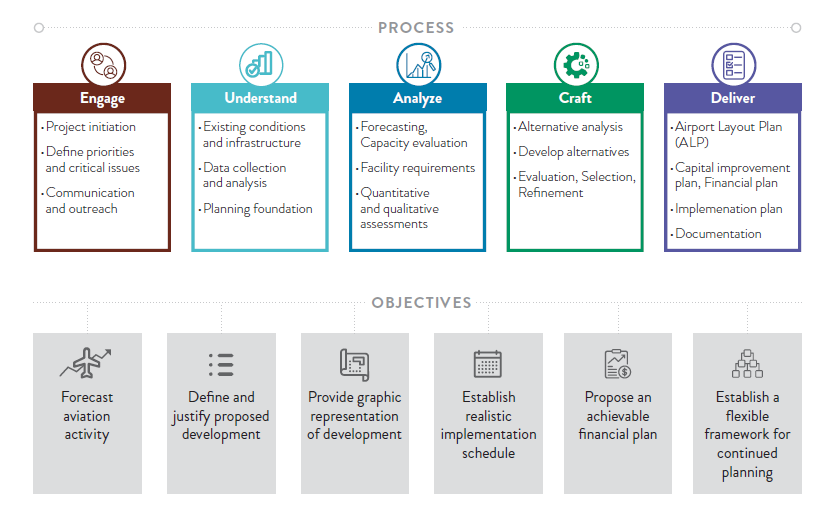
Pictured in the graph on page 22, the master plan identified five phases: Engage, Understand, Analyze, Craft and Deliver.
Phase 1 - Engage
An important component of the master plan was to develop clear and achievable goals. Key objectives included meeting growing passenger demand while balancing terminal and landside capacities, engaging stakeholders and community members for their input and support to ensure development plans meet
the needs of airport users, incorporating the latest innovations and technologies, and optimizing infrastructure and resources in an operationally, financially and environmentally sustainable manner.
Phase 2 - Understand
Gathering information about existing facilities was important to understanding limitations and identifying key areas for development to meet current demands and future projections. While Dallas Love Field is constrained to 20 gates, it was determined that the primary areas for development would be the terminal facility and landside elements, such as curbside, on- and off-airport roadways, rental car facilities and parking facilities.
Phase 3 - Analyze
Successfully expanding the square footage of the 20-gate concourse would double the capacity of restrooms and concessions, provide larger concourses, additional back-of house concession support facilities and additional outbound baggage makeup and inbound baggage claim devices.
Phase 4 - Craft
The gap between what existing facilities could safely and efficiently handle, and the forecast of future activity was the basis for exploring development alternatives to meet future demand. The alternatives were presented at open houses for public feedback.
Phase 5 - Deliver
Concluding the master plan effort, a preferred development path was selected and a plan for its phased implementation will be defined. The preferred plan identified 14 key strategic projects that will be incorporated into the airport’s largest capital improvement program in its history — Love Field Expansion Airport Program — Capital Improvement Program (LEAPCIP). The program includes a new terminal headhouse in the footprint of Garage A (at the end of its useful life) with split level frontages, 50-foot widening of the existing concourse, new/additional parking (Garage D), remote economy parking, consolidated rental car facility, increased capacity for the central utility plant and several support facility/building relocations. Design is projected to begin in 2026.
A Focus on the Passenger
Love Field has long been lauded for its excellent customer service. For two consecutive years, 2023-2024, it held the title of “Best Airport of 15 to 25 Million Passengers in North America,” awarded by Airports Council International (ACI) World, based on the findings of a rigorous yearlong survey evaluating customer service and passenger experience. That is why it was of utmost importance that the master plan incorporated public feedback from its onset.
“The redevelopment will provide substantially higher levels of customer service to both the public and airport/airline staff, improved passenger experience through more comfortable gate areas, additional/new concession offerings, additional restrooms, new parking and rental car facilities and higher resiliency from operational disruption,” Futch clarified. “Love Field has long been regarded as an airport that is easy to fly through, thanks to its relatively short walks, compact design and inviting atmosphere. As we prepare to redevelop the facility, we keep those unique Love Field elements at the top of mind."