


Airports are complex ecoystems where safety, efficiency and operational excellence intersect. Safety Management Systems (SMS) provide a structured framework for identifying hazards, assessing risks and implementing mitigation. Airports are increasingly integrating advanced technologies with SMS to strengthen safety culture and improve reat-time decision-making.
As passenger volume grows and aircraft turnaround times compress, these innovations deliver precision and predictability — helping airports move beyond compliance toward smarter, safer operations. From digitization to sensor-based monitoring, the aviation industry is adopting innovations that transform safety from a reactive process into a proactive, datatdriven discipline. Tampa International (TPA) is embracing this intelligent transformation by piloting technologies like Light Detection and Ranging (LiDAR) to address one of the most persistent challenges in ground operations: ensuring gates are clear and ready for aircraft.
The Challenge: Ensuring Gate Readiness Aircraft arrivals trigger a chain of tightly coordinated activities — marshalling, baggage handling, fueling, catering and airportmagazine.net 23 passenger boarding. A single delay can ripple across the network, impacting schedules and customer experience. One critical factor in this process is confirming gate readiness. That includes ensuring that the aircraft parking area is free of Foreign Object Debris (FOD) and Ground Service Equipment (GSE).
Traditionally, ground crews perform visual inspections to confirm gate readiness. While effective, human checks are subject to variability and time constraints. Missed items — such as a tow bar or baggage cart — can lead to delays, equipment damage, or even safety incidents. How can airports add a layer of precision and automation to this process?
TPA’s Solution — LiDAR
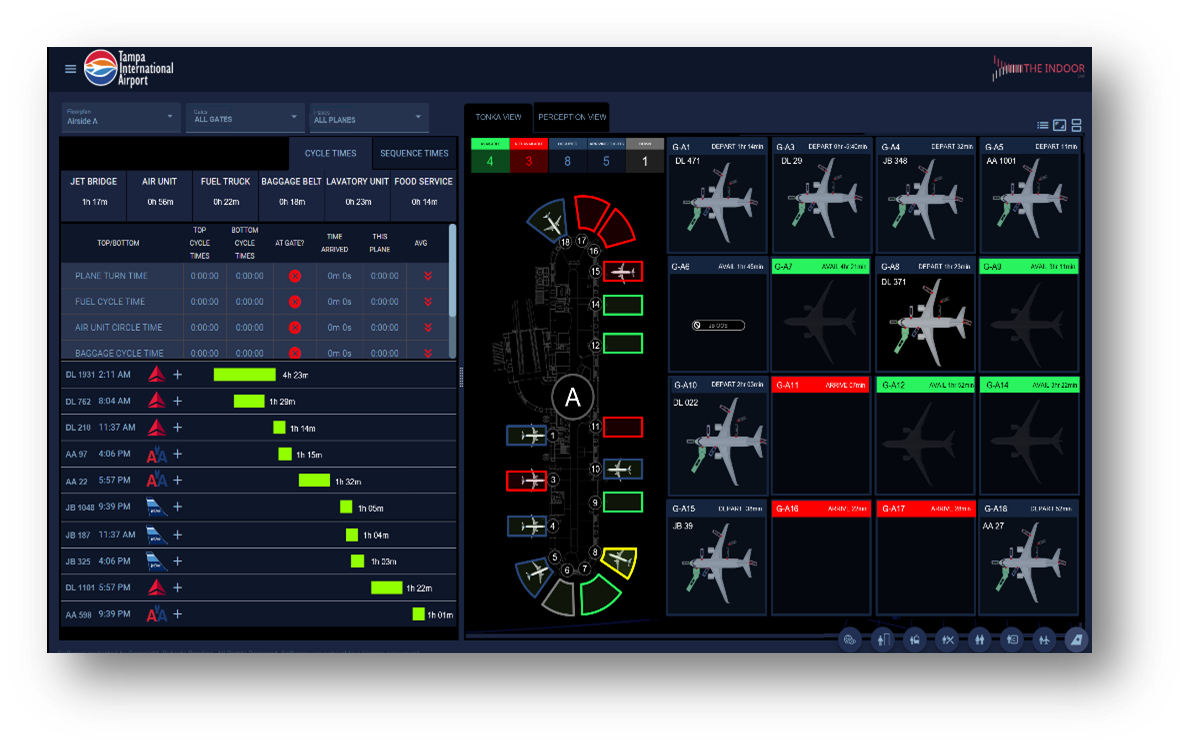
TPA is implementing LiDAR to automate gate scanning and readiness. Combining LiDAR perception software and operational artificial intelligence (AI) enables centimeter-level accuracy, 3D spatial awareness and pattern learning for optimized decision making. LiDAR emits millions of light pulses per second to provide live movement data that is integrated with a high-resolution map of the gate environment.
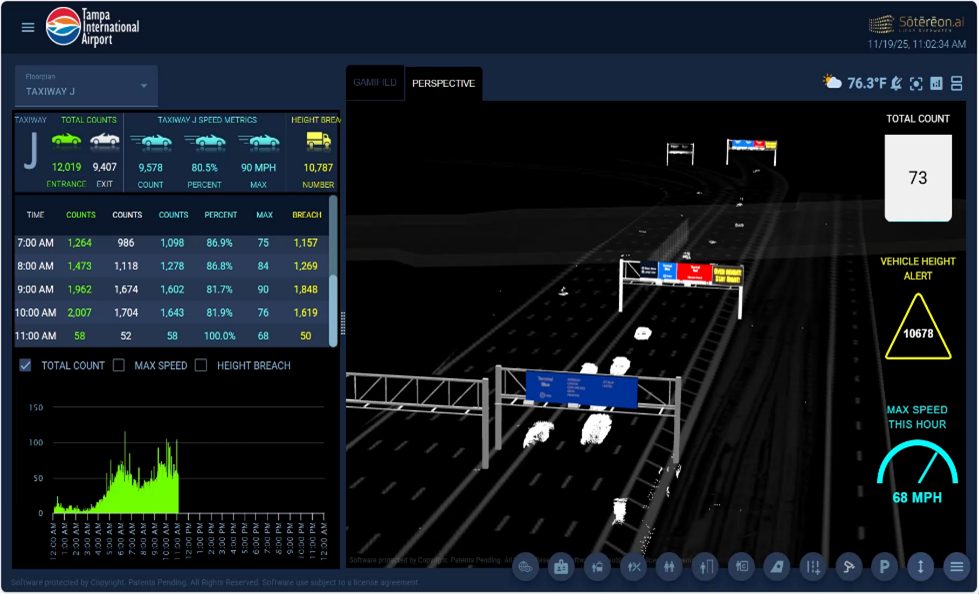
LiDAR scanning detects FOD, monitors the safety envelope for improperly parked GSE and sends anomaly alerts to gate operators before aircraft arrive. Beyond underwing safety and LiDAR gate scans, TPA has employed a runway overwatch system that runs on an underground magnetic track. This system detects pavement deficiencies, FOD, ponding and other conditions that may impact compliance with FAR Part 139 standards. LiDAR and operational AI are optimizing more than airfield safety. At TPA these systems are also used for focus areas such as:
-
Security screening to display live wait and travel times to passengers.
-
Inbound traffic monitoring to detect stopped vehicles, accidents, or pedestrians on roadways
-
Capacity tracking for automated people movers (APMs)
-
Parking garage detection for capacity, nefarious activity, and smoke/fire.
-
Terminal overview for aircraft arrivals and departures at gates.
Integrating Technology with SMS
As airports nationwide implement SMS, many are layering technologies to enhance safety and efficiency. But what’s the return on investment (ROI) for these innovations? Integrated systems provide data and trend analysis that transcend safety culture from reactive to predictive and proactive.
In the proactive stance, airports can prevent expensive or life-threatening incidents or accidents before they occur. In a predictive stance, SMS becomes embedded in daily operations, protecting against errors and enabling airfield excellence.
While adopting technology feels essential in the 21st century, the true value emerges when it is integrated into an airport’s SMS framework. Analytical insights, such as patterns of equipment left in safety envelopes or aircraft departure delays, can drive targeted training or procedural improvements. This synergy between technology and SMS transforms safety from a compliance requirement into a strategic advantage for operational efficiency and airport management.
Real-World Impact at TPA
TPA’s integration of advanced technology demonstrates how operations can be shaped with a safety mindset. Real-world examples already show how LiDAR could help prevent incidents from recurring.
In November 2025, TPA made national headlines after an aircraft collided with a staged vehicle on the ramp. The impact damaged both the aircraft wing and vehicle, removing both from service. The incident resulted in a cancelled flight and passenger rebooking.
Enhanced ramp safety training and focused outreach will help reset safety culture in the near term, but emerging technology offers an even stronger path forward. The newly installed LiDAR-based gate scanning can identify hazards before an aircraft reaches the gate, providing clearance alerts. In future similar events, this level of insight may prevent a costly collision.
Future safety performance indicators may include:
-
Reduced turnaround delays through automated scanning that streamline gate checks, allowing aircraft to park and be serviced more quickly.
-
Improved operational safety assurance through proactive identification of FOD and GSE hazards before aircraft arrival.
-
Optimized efficiency by enabling ground crews to spend less time on repetitive inspections and more time on higher-value tasks.
Other Emerging Technologies
LiDAR and operational AI are just a piece of the innovation puzzle. Airports worldwide are experimenting with complementary technology such as:
-
Computer Vision: Cameras paired with machine learning algorithms to detect hazards and monitor GSE movement.
-
Digital Twins: Virtual replicas of airport infrastructure for scenario planning and predictive maintenance.
-
Biometric Screening: Biometric boarding, eGates and digital credentials to reduce passenger travel times on the ground.
-
Virtual Reality Way Finding: Used for staff training and immersive passenger navigation experience.
Considerations
Adopting technologies isn’t without challenges. Airports must find a balance of technology use with existing practices and ensure customized applicability. Innovation must be leveraged with practicality.
-
Cost and ROI: High upfront costs of technology require clear business cases.
-
Integration Complexity: Systems must align with existing Information Technology capabilities and operations.
-
Human Factors: Top-down training and change management ensure adoption and trust.
- Cybersecurity: Increased connectivity introduces new vulnerabilities.
The Future of Airport Safety
As aviation enters a new era of growth and complexity, the fusion of SMS with emerging technologies offers a path to safer, smarter, and more resilient operations. TPA’s exploration of LiDAR and operational AI exemplifies how airports can leverage innovation to solve real-world challenges, supplementing manual tasks with automated assistance.
Thoughtful modernization positions airports to meet the challenges of tomorrow with clarity and confidence. Together, we can cultivate an innovative safety culture that thrives in an increasingly complex world.