


Commentary: Airports Must Monetize Their Assets to Fund Infrastructure Needs
As the nation’s airports try to keep pace with growth in air travel, they confront a daunting challenge: How to maintain, modernize and expand their facilities to meet growing passenger, air cargo and business aviation demand at a time when they face a funding cliff.
U.S. revenue air passenger enplanements topped a record 1 billion in 2025, with FAA forecasts projecting a further 300 million by 2035. This growth necessitates $34 billion per year in infrastructure spending over the next five years alone, according to Airports Council International-North America.
Yet, today, the nation’s airports have a backlog of unfunded expansion and modernization projects. For instance, Oregon’s Eugene Airport, a small hub that experienced explosive demand growth after the pandemic, has been at full capacity since 2021 and is in need of $240 million for expansion and modernization. Without new investment, airports like Eugene cannot accommodate additional flights. This, in turn, holds back local economic development. But it’s not only expanded air service that is impacted. Across the nation, inadequate and delayed infrastructure investment, compounded by labor shortages, are contributing to overcrowded terminals, mounting delays and rising passenger frustration.
Meanwhile, the federal government’s grant programs under the Infrastructure Investment and Jobs Act — an important source of funds for capital programs — have released the final installments of their five-year, $20 billion funding for runways, taxiways and terminal development. This program is unlikely to be continued. Another source of funding for capital investment, the passenger facility charge (PFC) has remained flat since 2000, still just $4.50 per passenger flight, as the airport lobby has been unable to convince Congress of the need for a raise.
Airports generate revenue from landing fees and terminal rents charged to airlines, and commercial activity, including parking, concessions, car rental and real estate. But this revenue has been insufficient to fund infrastructure needs. The scale of capital programs is so large that small- and medium-hub airports simply don’t have access to the cash flow required to fund expansion of passenger terminals, cargo facilities, ground
transport infrastructure and other critically needed assets.
The nation’s airports are predominantly publicly owned by city, county or state governments. As such, large and medium hubs have traditionally tapped capital markets through tax-exempt airport revenue bonds to fund major capital projects, while small, non-hub and general aviation airports — with limited access to capital markets — have relied heavily on federal grants.
However, given the scale of capital needs combined with rapid cost escalation that outstrips growth in traditional funding sources, compounded by rising debt burdens, airports, large and small, need to find additional funding sources.
So, airports must be creative and explore new revenue while being open to alternative funding sources in recognition that revenue growth alone will not bridge the funding gap.
The New Frontier for Airport Revenues
Airport revenue growth will come from a multi-faceted approach that involves four pillars:
-
Creating modern retail and service experiences enhanced by digital
-
Turning real estate into a strategic asset
-
Monetizing mobility and ground access
-
Launching energy and sustainability linked ventures
Industry executives are recognizing the need to transform their terminals into shopping destinations. A key strategy is to improve the efficiency of drop-off, check-in, and security screening to eliminate friction, reduce stress and increase “dwell time,” the amount of time that passengers are on the airside of terminals. This provides passengers with the opportunity to spend more at restaurants and retail stores. Technology is enabling smoother journeys — AI and real-time analytics are already helping to reduce curbside congestion, speed up check-in,
reduce security queues and optimize concessions.
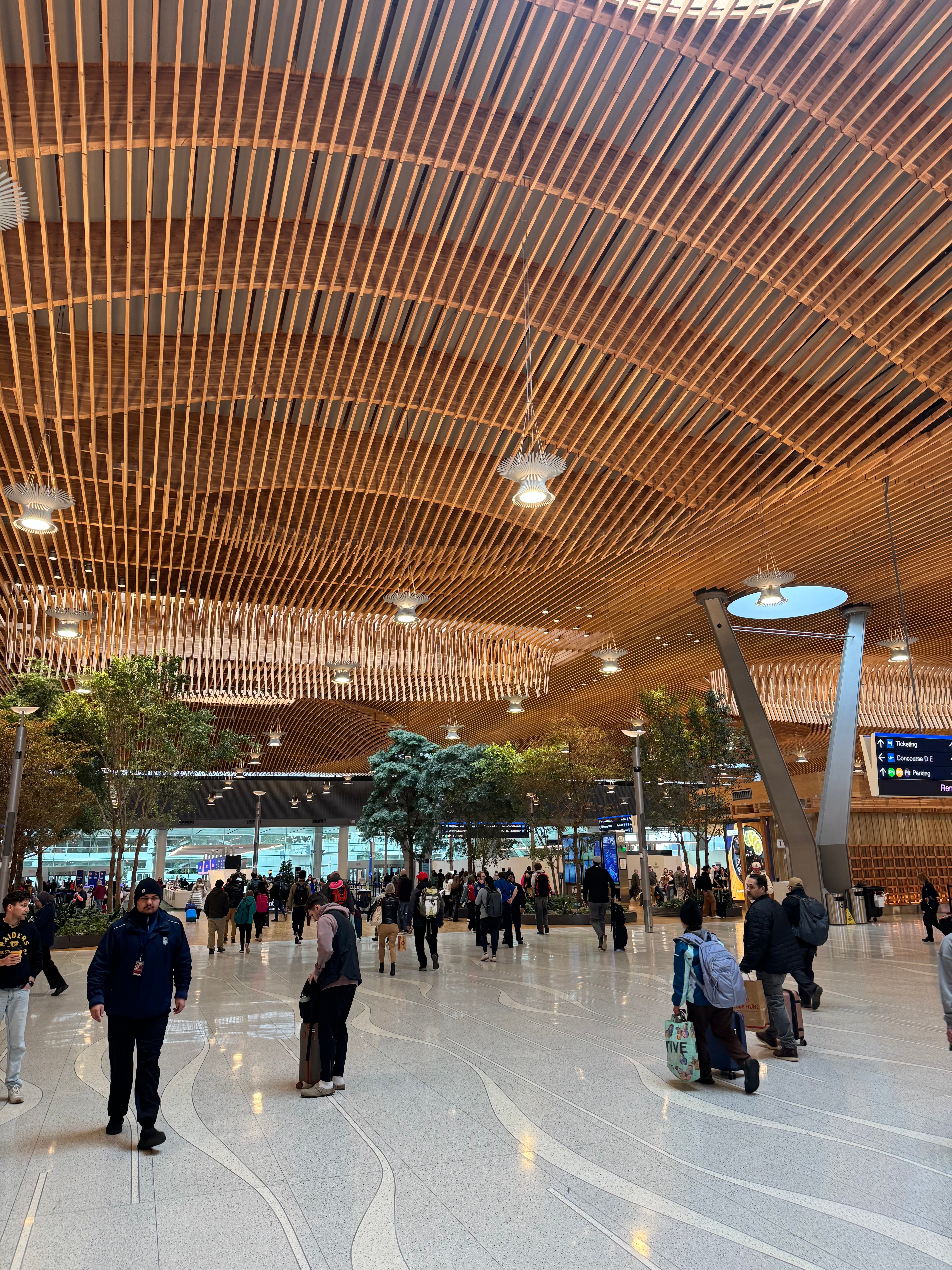
Oregon’s Portland International (PDX), for example, is successfully integrating its new terminal into the community
by featuring shops and restaurants that promote local brands, and presenting live music and art installations. PDX is smartly encouraging Portlanders who are not flying to come and spend time and money at the airport. While not universally applicable, more airports can take a page from Portland’s playbook.
Outside of terminals, airport land, which has been historically underexploited, needs to be viewed as a strategic
asset and optimized. There is the potential for airports to offer land for warehouses, office buildings, or energy-hungry data centers. For example, Denver International, situated on 53 square miles, is exploring the construction of on-site clean energy generation, possibly even a small modular nuclear reactor, to supply the airport’s needs and potentially sell power back to the grid.
Another innovative example of real estate use can be seen in Los Angeles International’s upcoming automated people mover (APM), which is a ground access solution that acts as a deliberate, long-horizon real estate and revenue platform. While many airports have APMs, none have tapped its potential for revenue maximization and mobility optimization. LAX’s APM will be the value-creating spine that decouples access from terminal curbs, making off‑terminal, airport‑controlled land functionally “terminal‑adjacent.” This allows Los Angeles World Airports — the airport authority — to consolidate demand, price access, and anchor long‑term leases (parking, rental cars, transportation network companies, concessions) across a much larger real‑estate footprint. In doing so, the APM transforms mobility infrastructure into a time‑certain access platform that systematically converts congestion relief into durable, bondable revenue and increases land value over decades.
Looking for Alternative Funding Sources
Such revenue strategies can help airports fund expansion and modernization needs, but major capital projects like an APM or on-site clean energy generation, let alone major terminal overhauls, require partnerships. Revenue alone won’t close the growing funding gap. Moreover, such projects are prone to construction, schedule, and lifecycle risk. Enter private equity.
In the U.S., local governments that own airports have often approached public-private partnerships (P3s) with caution, in large part due to concerns over loss of control of a major regional economic engine. As a result they have historically been confined to non-terminal assets. But the Port Authority of New York and New Jersey (PANYNJ) is showing the rest of the country that these concerns can be effectively mitigated for major terminal redevelopment.
The PANYNJ has successfully utilized the P3 model to transform aged and obsolete terminal infrastructure at
LaGuardia and JFK Airports into some of the nation’s most modern and customer-centric facilities. But what, exactly, is the role of private investors at PANYNJ? At Kennedy International and LaGuardia Airport, it has been to design, build, finance and operate new terminals. The PANYNJ remains the landlord, responsible for the airfield, access roads, parking garages and beyond.
The expected cost of rebuilding JFK Airport is $19 billion; the PANYNJ has only put up about $4 billion of the total, demonstrating strong private sector demand for the project’s financing. Importantly, this has not led to loss of control. On the contrary, it has stimulated greater competition among JFK’s terminals, which airlines love.
The additional upside for states, counties and municipalities is that they can transfer the risks of these major projects to private investors, thereby largely removing the risk to taxpayers of potential overspend, delays, or insufficient demand.
The fact is, infrastructure-focused investors are actively seeking opportunities to participate in the robust U.S. aviation sector, which remains the world’s largest and most resilient. These investments are attractive due to their potential for dependable and consistent cash flow. Airport authorities are encouraged to engage these investors and approach partnerships with a forward-thinking mindset to develop advanced facilities—ranging from terminals to key real estate assets. Such collaboration can significantly enhance non-aeronautical revenue streams, improve service for travelers, and support continued growth in air travel.
About Carlos Ozores:
Ozores is a partner and U.S. aviation lead at PA Consulting.